Tuesday, December 7, 2021

My Winter Fly Tying Essentials Guide

Winter evenings are perfect for spending time at the vise learning new patterns and stocking up on old favorites. With these bitter cold nights fast approaching (or already here in some parts of the world) I thought I’d discuss some of my favorite tools and supplies, practical discoveries, and my most often used materials to hopefully clarify and simplify some aspects of tying that can be intimidating for beginning tyers.

While I’m no expert and I tend to enjoy catching fish on flies I tied more than I enjoy the actual art of fly tying, I have been doing it for a while and have picked up a few things in the past 20+ years. Before I begin, let me preface this by stating that fly tying (just like fly fishing) is a unique experience for each individual and there are so many aspects that determine how one approaches it. Therefore, everything I’m going to discuss is specific to my experience, but may or may not be applicable to others.

Getting Started

As has been echoed by experienced tyers everywhere, a newcomer to fly tying should resist the urge to buy a kit, which often includes a vise that can barely hold a hook, poor quality tools, and low-grade scraps of materials that they will either deplete quickly or never use. Instead they should begin by first acquiring a decent rotary vise, bobbin, and a good pair of sharp, small scissors then branch out as needed based on the patterns they want/need to learn.

Rite Bobbin

Ceramic bobbins are cheap and often included in fly tying kits, so most tyers including myself begin with them. They certainly do the job, but the drawback is the fixed amount of tension they provide, unless the arms are manually bent to either increase or reduce tension, which will eventually lead to a broken bobbin. Also, with a standard bobbin the risk of breaking thread is much higher and more often than not it will break at the most crucial point of tying. The Rite Bobbin, however, is constructed like a fly reel with an adjustable drag knob on the side. Every time I switch threads, all I need to do is adjust the knob and pull the thread until I achieve the mild to medium tension I’m looking for. I honestly haven’t snapped a thread since I bought my first Rite Bobbin four years ago.

Rotary Whip Finish

While a whip finish can be done by hand, a rotary tool will do the job much quicker and easier after watching a 30 second YouTube video on how to use it. To this day I still don’t know how to use a standard whip finish tool and up until about five years ago when I took the time to learn the ways of the rotary tool, I was whip finishing every fly by hand. Never again, though; rotary whip finish all the way.

Small Hackle Pliers

As someone who doesn’t tie or fish dries often, I rarely use hackle pliers for their intended purpose, but they do come in handy in other ways. Aside from wrapping beaded pheasant tail nymphs with Hungarian Partridge (my soft hackle of choice), I mostly use my small narrow hackle pliers to hold materials in place and out of the way while I tie in or wrap other materials and I almost exclusively use my plastic hackle pliers to hold hooks for snagging beads.

Lead-free Wire
Though I use both brass and tungsten beads for various patterns and situations, I absolutely will not use nymphs with tungsten beads on small mountain streams. Too often my fly will snag or drag on the bottom within seconds of hitting the water. Because of its density, tungsten dives down in a way that I don’t need or want on those tiny creeks. I find that nymphs with brass beads and a few wraps (5-7) of lead-free wire around the hook shank help me achieve the exact weight I’m looking for to fish bigger nymphs with a natural drift in depths between 6-inches and 3-feet without dragging bottom or snagging every other drift. For nymphs I typically use .015” and for streamers I use .025” to .030” to add extra weight to tungsten cones and barbell eyes.

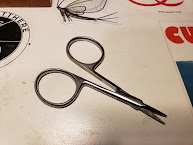
Old Scissors

Worn finish, dull,
broken at the point,
but perfect for the job.
When cutting wire, whether it be thin wire to create segmentation in a nymph or thicker lead-free wire to wrap around the bare hook shank to add weight to a nymph or streamer, it’s best not to use good scissors. When cutting wire off of the spool or when finishing a lead-free wire wrap on the shank, some anglers use a small wire cutter tool, but I like something that creates a more precise cut. A few years ago while transferring supplies between rooms I dropped one of my nicer but slightly worn pairs of fly tying scissors point-down on my tile kitchen floor and completely mangled them. From that moment on they became my wire scissors and have been perfect for the job. Therefore, dedicating an older pair of scissors or just marking a pair only for use with wire will help with precise cuts and save nicer pairs from premature wear.

In some instances scissors aren’t necessary at all. When finishing a wire wrap on a fly it’s always best to do a few wraps of thread on either side of the wire to secure it, then helicopter the tag until it breaks on its own at the tension point to prevent having an exposed tag on the fly. Check out Tim Flagler’s YouTube videos (tightlinevideo) for info on this technique.

UV Light and Resin

A perdigon tied on a jig hook has been my go-to, slump-busting, Euro nymphing dropper in 2021 and a UV light/resin pairing is essential to tying that pattern. With the perdigon, the tungsten slotted bead helps get it down quickly, but the smooth, streamlined resin body is what cuts right through fast water, making it an invaluable fly for nymphing riffles.

UV resin also comes in handy for purposes such as creating a solid wing casing on a hare’s ear nymph or the hard back of a scud or caddis larva. It can be used in a number of applications for streamers as well. When I first started tying, especially when tying saltwater flies, five-minute epoxy was the best way to get that hard, clear coating on a fly, but the process was time-consuming and the epoxy would turn yellow from use far too quickly; UV resin solves both of those problems. As for what type of resin to use, for nymphs I like Loon Thin resin and for every other freshwater application I use Solarez Thin-Hard, which I find to be slightly thicker than the Loon Thin.

Aside from tying flies, I use the UV light and resin for other fly fishing purposes. The light comes in handy to cure UV Aquaseal when patching my waders. However, be careful not to hit the Aquaseal with too strong a UV beam because I’ve found that it will heat up and smoke, so apply the beam softly and slowly. I also apply a thin coat of resin when I repair nicks in my fly line. First, I use Zap-A-Gap to glue and seal the nick and then I coat it lightly with resin to finish it off.

Dubbing Wax

Dubbing comes in an infinite variety of blends and is used on many nymph, dry, and streamer patterns. When applying it to thread in a nice tapered noodle, the application of the varying blends can range in difficulty from mild to impossible without the aid of dubbing wax, the great leveller. For instance, UV ice dub alone is nearly impossible to spin, but with wax it’s a breeze and almost as easy as hare’s ear dubbing, which spins smoothly without any assistance.

When I first starting tying, the only wax I had was a rock-hard chunk that came in a fly tying kit. When I rubbed it onto the thread, none was left behind to help me create a dubbing noodle. Strangely, the thought of heating it never entered my mind and for a while I gave up and applied my dubbing without any wax. Years later I picked up Wapsi dubbing wax (pictured to the right) and the ease of using the softer wax made me realize what I had been missing in the way of time saved and in the improved quality of my flies.

The technique I prefer for application is to rub wax on the thread a few times along the space where I want to create the noodle, then rub my fingers on the thread to coat them. I’ve found that coating my fingers is more important than coating the thread, but just sticking a thumb in the wax can get messy.

Forceps

Every responsible angler carries a pair of forceps and though trout are hooked corner jaw the vast majority of times, it’s always good to have them just in case they’re needed. However, the most useful application for forceps: CRIMPING BARBS. I challenge everyone reading this to go barbless.

I’ve been fishing barbless for trout for over four years and I’ll never go back. It's forced me to be a better angler in that the majority of fish I’ve lost have been because of a mistake made by me. Fewer mistakes means fewer lost fish; it’s just simple math. The real reason to fish barbless, though, is the ease of hook removal and the reduction of scarring (or worse) for the fish. Most of the time my fly falls out while the trout is swimming in the net and when it doesn’t come out on its own, all it takes is a little push on the bead or the hook eye with my index finger. Seriously, go barbless.

My Essential Fly Tying Materials

Below is a list of my most frequently used materials with a brief explanation of the use for each, but it doesn’t even scratch the surface of the total list of supplies I use and the multitude of patterns for which the listed materials come in handy; this is simply to help beginning tyers get started. Also, If you've read my post on confidence flies, I’m fairly certain that every material needed for those patterns is included.

As always, feel free to reach out with any questions about this post or any other.

Feathers & Herl

-Pheasant Tail (natural, olive, yellow) for tailing and body of numerous nymph patterns

-Hungarian Partridge (natural) for soft hackle nymphs

-Coq De Leon (barred speckled) for perdigon tailing fibers and various other jig nymphs

-Peacock Herl (green, blue, orange) for nymph collars


Hair

-Elk Hair (bleached) for the wing of olive x-caddis and elk hair caddis

-Rabbit Strips (dark olive, black, olive, brown, natural) for larger slump-busters and other rabbit hair streamers

-Pine Squirrel Strips (dark olive, black, olive, brown, natural) for small slump-busters and leeches

-Bucktail (white, olive) for Clousers used for striped bass


Dubbing

-Spectrablend Nymph Dubbing (every color) for collar and body for a number of nymphs, body of olive x-caddis 

-UV Ice Dub (mostly caddis green, gray, black, but also others) for flashier collar and body of nymphs (ice dub caddis larva is a favorite)

-SLF Squirrel Dubbing (rusty brown, dark olive) for nymph thoraxes

-Sow Scud Dubbing (light olive, orange, gray) for scud body and legs

-Dry Fly Dubbing (gray, light olive) for RS2 body, WD-40 thorax


Synthetic

-Chenille (fine-med. size in plain or variegated ginger, black, olive, brown) for girdle bugs

-Grizzly Barred Rubber Legs (med. in natural, tan, olive, white) for girdle bugs

-Stonefly Chenille (black/beige, black/ginger, black/coffee) for smaller girdle bugs in 12-14

-MFC Barred Sexi-Floss (yellow small) for smaller girdle bugs in 12-14

-Thin Skin (clear/black specks) for scud backs

-Antron Yarn (brown, olive, white) mostly for nymph bodies and x-caddis tail

-Sparkle Braid (peacock, olive, copper, pearl) for a flashy streamer underbody

-Uni-Mylar Double-Sided Tinsel (12-16, peacock) for perdigon body

-Ultra Wire (size sm-brassie, silver, gold, copper, chartreuse, green, mustard) for ribbing and segmentation of numerous nymph patterns

-Veevus Holographic Tinsel (size sm-med., chartreuse, red, purple, green, black, silver) for leach underbody and experimenting with Perdigons and other jig nymph patterns

Beads & Cones

-Brass Beads (2.0-2.8mm in gold, black nickel, black, silver) for numerous nymph patterns

-Tungsten Slotted Beads (2.8mm-3.8mm in gold, black nickel, silver, copper) for numerous jig nymph patterns

-Tungsten Slotted Beads (3.2mm-4mm in gold, black nickel) for jig streamers

-Tungsten Cone Heads (sm-l in black nickel, black, gold) for numerous streamer and micro streamer patterns

-Barbell Eyes (l-xl in chrome, yellow, chartreuse, red) for Clouser minnows used in saltwater for striped bass

Thread

-Danville’s Flymaster 6/0 (olive, black, Adam’s gray, brown, fl. fire orange) for nymphs, dries, streamers

-Danville’s Flymaster 3/0 (black, olive) for streamers

-Danville Fine Monofilament Thread- for saltwater flies

-UTC 70D (black, olive, red, yellow, chartreuse, rusty brown) for nymphs and dries

-Uni-Thread 8/0 (olive dun) for nymphs and dries, a favorite for my olive thread Frenchies

-Veevus- 12/0 (black, olive, brown, fl green) for jig nymphs and small dries

-Veevus- 14/0 (orange, red) for collars and hot spots

Hooks

-4X Streamer Hook- Mustad or Daiichi (8-14) for girdle bugs

-3X Streamer hook- Mustad (12) for micro strreamers

-Bead Head Nymph Hook- Orvis (12) for small stream soft hackle pheasant tails

-Curved Straight-Eye Long Shank Nymph Hooks- Orvis or Dai-Riki (12-18) for numerous nymphs

-Emerger Hooks- Dai-Riki or Orvis (14-22) for caddis larva and midges

-Jig Nymph Hooks- Hanak or Orvis (12-20) for numerous jig nymphs

-Standard Dry Fly Hooks- Dai-Riki (12-22) for numerous dries

-Ahrex Trout Predator Light Streamer or Gamakatsu Stinger (1/0-4) for numerous streamers

Wednesday, November 3, 2021

Fly Fishing on a School Day?

 It was twenty-one years ago on a beautiful May morning of my sophomore year when I pedalled up late to school and found the staff ushering a massive line of students to the middle school across the street. Riding my Dyno BMX bike up to the line, I asked an acquaintance what was going on only to be met with two words: BOMB SCARE. 

Ugh...high school.
Since it wasn’t the first bomb threat in the school’s history, albeit the first I had experienced, I casually looked up at the sky and thought, “It’s a nice day. Makes sense.” Realizing this was likely either a senior prank or a group of kids seeking a beach day in the most idiotic way possible or even more likely both at the same time, my first impulse was to turn around and head home rather than spend the next few hours packed with my peers in the stuffy middle school gym. What stopped me was the realization that anyone absent, especially those absent without a parent phone call to back it up, would undoubtedly be placed amongst the usual suspects the next day. Therefore, I locked up my bike and joined the herd bound for the gymnasium where we would be held with nothing to occupy us until sufficient time had passed for the district to be legally credited for the school day, thus preventing an additional day being added to the end of the year. 

Sometime around noon the gym doors flew open and a mass of hormones and solipsism poured out into the sleepy town of Point Pleasant, New Jersey. My friends and I, six in total, were ravenous and made for what only starving teenagers with unrefined palates would make for: Pizza Hut. We actually dined in. I remember it vividly for two reasons, one of which being it was the first time I had eaten at a restaurant solely with friends and no parents in sight. I didn’t merely feel like a man but rather more like a king----eating at Pizza Hut. It must have been how Gorbachev felt a few years before when he filmed that Pizza Hut commercial (Look it up; it actually happened.).

The second reason this experience stuck with me was because of our server who, realizing her next table would be a group of uncouth and poor-tipping teenage boys while simultaneously seeing right through how cool we thought we were, decided not to steer the logical course of ignoring us as much as possible and instead confidently walked up to our table, opened with a “Look at what we have here,” and proceeded to roast each of us one after the other with an unrestrained, Don Rickles-like efficacy still unsurpassed to this day and we loved every second of it. I can’t remember what she said about me but I’m sure it was spot-on and well deserved. 

By the end of our meal we had made a new friend (whom we tipped generously) and upon leaving the restaurant with plenty of time left in the day, all of us agreed on the only sensible thing to do with a volatile mix of what passed for pizza and breadsticks churning in our stomachs: trek all the way to the opposite side of town and fish the nearest excuse for a freshwater fishery. That fishery was Godfrey Lake, an egregious misnomer given that this “lake” was no larger than a football field and no deeper than a motel swimming pool. 

The angling experience among the group ranged from zero to thinks-they’re-hot-shit with my friend Bill and I being the latter. Since most of the group was ill-equipped, we stopped at both mine and Bill’s houses along the way to gear up. At this point I was barely two years into my fly fishing journey, fifteen years away from discovering trout, and still yet to do more than bring a fly rod as a back-up to spin and casting gear, so when I passed out my two best bass fishing rods and was left with only an Ugly Stik spinning combo and my 3-weight Cabela’s fly rod, I was a bit apprehensive to leave with only the 3-weight. In a moment of extreme conflict, I decided to take a chance. Looking back on it, I honestly think the determining factor of an important moment in my fly fishing journey was more of a repugnance towards the Ugly Stik than any particular desire to fly fish that day.

When the six of us arrived at the so-called lake we set up at a sandy stretch of bank where the first lesson Bill and I had to immediately teach our eager but inexperienced crew was to refrain from putting the rods down in the sand. We then provided a tutorial for the two who had never fished, partly so they would have fun but mostly so they wouldn’t break our rods and lose our lures. 

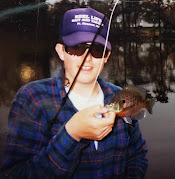
With proper handling and release,
 as with everything in life,
you live and you learn.
When I was finally free I took out a fly box containing some Adams, Elk Hair Caddis, and hoppers I had picked up for panfish and small bass. After making my first cast I was intently watching the Caddis float on the surface while explaining to a friend why I had just “waved the rod back and forth” when what ended up being a personal-best crappie crushed the fly up top as it was being pushed slowly across the surface by the breeze. Up to this point, none of my friends’ jerkbaits or soft plastics had attracted the attention of a bass or pickerel, so the crappie was the first action we had; it was a big deal for a moment but was quickly dismissed as a fluke until the next cast brought in a slab bluegill followed by a few more bluegill and another crappie shortly after with the action only halting for the occasional warning of the dangers of standing in proximity of my back cast.

After landing about a dozen fish, I spent the rest of the day casting and then handing my 3-weight over to one of the others who were taking turns so they could all set the hook and bring in some panfish. Bill was the only one who stuck with what he was doing, not out of stubbornness but because he (a beginning fly fisherman like I was) had already experienced what they were enjoying and was having fun just watching them. Nobody was ripping lunker bass through the lily pads with my Cabela’s combo, but everyone was catching fish and having a great time.

Probably one of
my first fish
on the fly rod.
The day was memorable for a number of reasons: “surviving” a bomb scare, the unforeseen early dismissal, the bizarre Pizza Hut adventure, and a great time on the water. What stuck with me most, though, was the sense of pride I felt towards a skill I was in the beginning stages of developing as well as the realization that if I put my faith in fly fishing it would reward me in ways I never thought possible. After more than twenty years, what had been a reluctant gamble by an ignorant teenager low on gear still pays off every time I’m on the water and I predict it will continue to do so for the rest of my days.  


Thursday, September 9, 2021

Confidence Flies

While I definitely feel the "match the hatch" philosophy is entirely valid and more often than not painfully necessary in the arena of dry fly fishing, there is something to be said about fishing a fly in which an angler places their confidence. Maybe that fly proved useful in similar conditions or on a similar stretch of water during a previous outing or maybe it's a general pattern that simultaneously mimics a number of aquatic insects, albeit not as perfectly as an intricate pattern that almost flawlessly imitates one insect. The reality is that trout aren't always zeroed in on just one food source when feeding under the surface and, being advantageous survivors, will often take a number of options presented to them; for me it's those trusted patterns with which I take more risks, fish harder, and experiment with more that catch fish over the flies that haven't proven themselves effective over time even if they are the more logical selection.

I now present to you, the reader, some of my favorite confidence flies, each with an explanation of their specific application and why I have so much confidence in them. None of them are esoteric patterns that are being revealed to the world exclusively here and most are in fact quite commonly used, but I just want to show what works for me in the waters I fish.

Jig Frenchie 

An all-around Euro nymphing favorite, the Jig Frenchie is an easy-to-tie pattern that mimics a number of aquatic insects. I typically use it in a size 18 or 20 as a dropper on my Euro rig and can count on it to pick up its share of fish throughout the day. Sometimes I'll even tie on a size 12 or 14 as my point fly if my other go-to point flies aren't proving effective in fast riffles and it'll usually produce fish.
  

Perdigon 

My favorite dropper to fish in fast water, the weight of the Perdigon's tungsten bead and the fly's aerodynamic profile help it to get down where it needs to be quickly. While I've never found a conclusive answer as to what exactly the Perdigon imitates, the most plausible seems to be that it mimics smaller Chironomid larva and that the flash, hot spot, and UV resin work as simple attractors when seemingly nothing else will. I'll throw out my own theory that they may even mimic smaller fish fry as I've had success on the swing or stripping them in at the end of a drift while Euro nymphing a small streamer as my point fly. Whatever the case, I exclusively fish them as a dropper in any size from 14-20.
 

Girdle Bug 

When I was first shown a Girdle Bug and told how effective it is, I was dumbfounded. I had spent so much time and effort learning to tie intricate stonefly patterns and I just couldn't process the idea that this mess of rubber legs and chenille could catch fish as a stone imitation. The first time I fished one as my point fly on a Euro rig, I was sold within minutes. Not only did I net a ton of trout that day all on girdles, but I capped it off with a new personal-best wild brown and my first brown over 20-inches. Two things struck me about the Girdle Bug that day: 1.) the takes were more aggressive than anything I had experienced in years of nymphing, with the rod bent and line peeling through my fingers before I could even register what had happened and 2.) when wet, the girdle bug is actually a solid imitation. The wet chenille creates a perfect segmentation of the body, which I later realized is accentuated by tying with variegated chenille and barred legs.

See what I mean about the
segmentation when wet?
I've heard the Girdle Bug referred to as a good fast water fly, with the implication being that trout won't take it if they get a good look at it, but I haven't found that to be the case. The only time it's proven to be less effective is in crystal clear water and low flows. I typically tie Girdles in a size 8 or 12 and choose either option based on water clarity, depth, and current speed. I also tie them in size 14 for use on small mountain streams after rainfall when flows are high and the water is stained. 

Since the maturation time for a stonefly in the nymph stage is roughly two years, if you're fishing a stream that holds stones you can count on them always being on the bottom and always being on the menu, making the Girdle Bug an extremely effective go-to pattern that's caught roughly 75% of all of my trout over 15-inches in the past few years.

Soft Hackle Pheasant Tail 

I spend a lot of time on small, isolated mountain streams fishing a 2-weight glass rod for tiny wild and native trout and one thing I've learned in the past few years is that the challenge isn't getting those trout to eat, it's not spooking them. Smaller streams typically don't have the same diversity of aquatic insect life as a larger river and the competition for what food there is can be fierce given the small surface area the water covers and the dense concentration of trout that often occupy it. Therefore, if you have a quiet approach you can get these advantageous eaters to aggressively take a number of patterns if properly presented. My absolute favorite pattern for these streams is a simple Beadhead Soft Hackle Pheasant Tail Nymph. 

From numerous encounters with old-timers on the water and testing out their advice I've definitely found that bigger is better on these tiny streams. When nymphing, I use a size 12 (weighted only with the brass bead and lead-free wire around the hook shank) as my point fly and when using it as a dropper on a dry-dropper rig I tie on the same fly in a size 16 or 18. I think the effectiveness of this pattern comes not so much from its ability to mimic a number of aquatic insect species, but from the fact that the size, bead, and movement of the soft hackle all serve as attractors to get the trout's attention. In crystal clear water less than a foot deep I've seen browns fly out from under ledges on the opposite bank to whack this fly at full speed. While I prefer to use it on tiny mountain streams, the Soft Hackle Pheasant Tail is a classic, versatile pattern that has so many applications on any stream in any conditions.
 

Sulphur Jig Frenchie 

In my area as in many places, Spring is the most active time of year for trout and the most productive time to be on the water. On those rare Spring days when I'm having a hard time connecting with fish, I often find that it's because the trout are zeroed in on sulphur nymphs in the current and I'm stubbornly sticking to my aforementioned Girdle Bug/Perdigon tandem. When I finally stop, think, flip some rocks, and ultimately switch to a sulphur-colored jig Frenchie (size 14-18), the problem is almost always solved. 

Simple Sculpin Streamer

I'm just this year getting serious about upping my streamer game. My wife got me a great 6-weight setup for Christmas and I spent much of the Winter tying a variety of streamer patterns, researching various techniques and presentations, and picking the brains of dedicated streamer fishermen I know. One thing I was mildly surprised to find was the amount of emphasis anglers place on using the rod tip when presenting streamers and I've been practicing it in a number of ways such as twitching the rod tip while stripping in line, twitching it while letting the fly dangle in the current, and, while it may seem like a technique reserved for bass fishermen with a baitcaster, jigging streamers off the bottom. Not only is the Simple Sculpin Streamer a quick, easy pattern to tie, but it's also an extremely effective jigging streamer, even on streams that don't have sculpins. I typically tie them on size 2-6 Gamakatsu Stingers with small sized Fish Skull Sculpin Helmets and barred olive rabbit strips.

Slumpbuster 

There's a lot of innovation in streamer patterns these days and innovation is always a good way to fight off stagnation. However, despite all of the new, exciting patterns out now, I'm still most impressed by how realistically classic rabbit strip streamers such as the Slumpbuster move in the water and how effective and versatile they can be on the small-to-medium-sized streams that I fish. There's nothing like intentionally slamming one in at the edge of the opposite bank where you know there's a drop-off holding fish and watching a big brown come up and crush it on the first strip immediately after impact; for more traditional streamer techniques like this I tie Slumpbusters on size 1-4 Gamakatsu Stinger hooks or Ahrex Predators with tungsten coneheads. 

My second favorite way to fish a Slumpbuster is to Euro nymph it as a point fly. The takes are almost as aggressive as those I previously described getting on the Girdle Bug and they can happen at any time while sinking, dead-drifting, swinging, or stripping in. For this technique, I tie them on size 12 traditional 3-4x streamer hooks with a small tungsten cone and I use pine squirrel strips instead of rabbit strips not only for the ease of tying the more narrow profile onto a smaller hook, but also for the fact that pine squirrel actually undulates in the current better that rabbit strips, if that's even possible.
  

Olive Thread Frenchie 

Between the prevalence of caddis larva and baetis nymphs in the Northeast (especially in the Spring) you can't go wrong with any nymph pattern in an olive color and the Olive Thread Frenchie was a huge hit for me this past Spring. I tie them in sizes 14-20 and use them interchangeably as a point fly and a dropper. My most effective use of them came when fishing them as a point fly in size 14 with a black nickel bead in low, clear water.  

Olive X Caddis

I tie mine with brown hackle to mimic
legs on the underside of the fly. 
Since I'm typically forced to fish from first light to early afternoon and I'm never on the water for the sometimes legendary early evening hatches in the Northeast, I don't fish dries often. Plus, when I do fish them my impaired vision makes it hard to track small dries. Therefore, the majority of my time fishing dries is spent on the small mountain streams I mentioned earlier where bigger is most often better. While there are caddis on the surface for much of the year in the Northeast, they're not hatching every day and not half as big as the patterns I fish on these tiny brooks, thus reinforcing my belief that matching the hatch matters very little on these waters and the biggest factors are not spooking these small trout and presenting something to them that's going to get their attention. I do have a theory that some of the trout might mistake a bigger dry for a moth hitting the surface, but that's just a theory. 

The Olive X Caddis in a size 12 is my favorite small mountain stream dry fly not only because of how aggressively native brookies and other wild trout will absolutely crush it, but also for how easy it is to tie, how visible it is on the surface, and how buoyant it is even when trailing a beaded nymph dropper like the Soft Hackle Pheasant Tails I previously mentioned. I'm sure anyone out West reading this would not consider a size 12 to be large, what with the huge caddis and sedge that hatch out there, but consider the fact that the average trout crushing these size 12 dries on these small brooks is about 6-inches in length. 

The only time I don't use this dry (or any dry typically) is in the dead of Winter, but I know people who fish big dries such as Stimulators on these tiny streams and have success in the colder months. I find that when the flows are low in the warmer months, a dry-dropper rig with an Olive X Caddis trailing a Soft Hackle Pheasant Tail is possibly the most effective setup I've ever used to catch wild trout, albeit smaller ones.


Feel free to message me here or DM me on Instagram with any questions about tying or fishing these patterns.

Thursday, August 26, 2021

Everything That Goes Into Fly Fishing Besides Fly Fishing

If you’re like me, you spend more of your life around people who don’t fly fish than with those who do. I often find myself wrapped in a slew of emotions when confronted by the gulf between how others experience life and how I live mine, which is inextricably bound to my passion: fly fishing. Normally I can bear and process those emotions in silence, but when the other party, whether it be intentional or not, ventures toward diminishing my experience with phrases like, “It’s just fishing,” I have difficulty containing my frustration. In hopes of dispelling the dismissals of the unenlightened, I wanted to explore my own experiences with some of the many aspects of fly fishing that build up to the moments of tension and battle on the water, highlighting the culmination of a seemingly religious devotion that is much more than just fishing.

The Research

Simply grabbing a fly rod and heading to the water would seem nonsensical to most fly anglers. Before a wading boot is ever submerged, I’m taking significant time to research weather, flows, hatch charts, and local stream reports. If I’m exploring new water I’m doubling the time spent by researching wild trout reproduction maps, access points, and hatches specific to the water I’ll be fishing.

The Art of Fly Tying

An art form within itself requiring just as much time, patience, and practice as fly fishing, fly tying is an immersive and costly endeavor, but one in which many fly anglers take a great deal of pride, especially when looking in the net and seeing their handiwork embedded in the jaw of a fish. For me, fly tying is my sole creative outlet, my one form of artistic expression, and I value the many years I’ve spent learning and building my skills as a tyer while looking forward to everything I still have yet to learn.

The Gear

Three of my favorites.
At the beginning of a fly fisherman’s journey, having a functional rod is the most important aspect; many beginning anglers go with the typical 9-foot, 5-weight (or the just-as-typical 9-foot, 8-weight for saltwater) paired with virtually any reel just to get a feel for the sport. As one progresses, though, gear selection becomes a crucial, time consuming, and often obsessive facet of fly fishing. Selecting a tippet size based on water conditions, fly size/weight, and fish behavior, choosing appropriate clothing and wading gear to match weather and terrain, purchasing just the right grain sink tip line factoring in depth, current, and fly weight, and fine-tuning the formula for one’s Euro leader are just a few examples of the exhausting measures to which a dedicated angler will go in order to increase the chance of success. For me, all of those factors and many more are considered, but the most important contributor to my enjoyment and success on the water comes down to the hardware in my hand. If I’m fishing a small mountain stream with dense foliage, I’m grabbing my short, 2-weight glass rod for tight spaces, small flies, and feisty little wild trout. If I’m fishing a bigger, lowland stream maybe I want my 10-foot, 3-weight Euro rod with a perfectly balanced reel or, if the flows are high and stained,  my 6-weight streamer rod.  Some fly anglers even go as far as to construct their own rods from scratch, starting with a rod blank and using thread, epoxy, and other adhesives to attach the guides, eyelets, handle, reel seat, and butt section all customized to their own specifications. As for the reel, drag system, weight, arbor size, and durability all factor into purchase and selection. There are truly an infinite amount of choices that go into any day on the water.

The Night Before

My tying desk for last minute prep.
The night before any day of fly fishing involves a great deal of preparation. Gear selection aside, there is also last second tying, checking lines and leader, tying on fresh tippet, packing food, clothes, and gear, and then loading it all up in one’s vehicle so as to be on the road as soon as possible. While on the subject of waking, let’s discuss sleep. As a child, Christmas Eve was always my worst night of sleep in the entire year; the excitement and anticipation would keep me up, limiting me to maybe two hours of legitimate rest for the night. I no longer have this problem and often have to be dragged out of bed after oversleeping on Christmas morning, but the night before a fly fishing trip I toss and turn incessantly, my mind filled with the next day’s possibilities; for years I thought I was the only one, but I now know a number of fly anglers who struggle with the same childlike restlessness.

The Drive

My steed
Some anglers are lucky enough to live close to quality fisheries, only having to drive a few miles, but most have to put in significant windshield time to pursue their favorite species. There isn’t a wild trout stream within 70-miles of my home, so I have no less than an hour (usually closer to two-hours) of driving ahead of me before I’m presenting flies to trout. While gas, tolls, and vehicle maintenance are costly, there is something to the drive that makes it an integral part of the mental preparation for what’s to come. Out of necessity, I fish early in the day and will often be on the road as early as 3:15AM, a time of darkness and somewhat empty highways. I set my cruise control, listen to a podcast, and drink my coffee as part of a routine that helps center me for the day. Fly fishing is extremely cerebral, requiring intense focus and patience and the baggage you bring with you on the water can greatly impact your success.

The Setup

I love setting up in the dark.
Reaching the destination and setting up to head out is an important part of each trip. Making sure one’s waders and boots are snug yet comfortable for the trek ahead, rigging up rods and making those last second checks for weakness and imperfections, assuring that all necessary gear is present, functional, and easily accessible, and going over the plan for the day are all important parts of any day of fly fishing. My goal is to be ready to fish at first light, so I’m almost always setting up in the dark; to make things easier I’ve even installed multiple LED lights in the rear storage area and hatch of my vehicle.

The Trail

Trout don't live in ugly places...
For any wilderness explorer, taking those first steps on the trail carry an electric level of excitement and it’s no different with fly fishing. Walking trails along rivers or stopping to observe the wildlife and scenery, a fly fisherman experiences the beauty of nature in ways that may have nothing to do with fish, but are no less special, whether it’s admiring the view of the Grand Teton range at a distance or taking the time to watch a fox cross the creek by trotting on a fallen tree. Sometimes it can be tense, such as those moments when bears are involved, but if you survive them you walk away with an unforgettable experience and a story to tell. I’ve mentioned this before, but when people belittle the impact that fly fishing has had on my life, I think of these moments and find myself replaying in my mind the lines from Rutger Hauer’s iconic monologue in the film Blade Runner: “I’ve seen things you people wouldn’t believe.”

The Handling and Release

1st person view
of proper handling.
Not all fly fishermen practice catch and release, which is fine as long as one stays within the law while not abusing the fishery (sadly it is possible to abuse a fishery while still acting within the law), but many stress the importance of proper handling and release as an integral part of preserving fisheries and regard watching a fish swim off healthy under its own power as one of the more rewarding and satisfying moments in a day on the water. Such handling and release practices include the use of barbless hooks and rubber-mesh nets as well as keeping the fish submerged while only handling it with wet, bare hands to face it towards the current in slower moving water until it’s ready to swim off on its own. Fly fishing photography is also an art form of its own, but when releasing fish, the photo should never compromise their health and safety.

The Bond Between Angler and Fly Rod

I take a lot of pride in fly fishing, its history, what it stands for and represents, as well as what I’ve been able to learn and achieve through it over the past twenty-plus years. Fly fishing is a fusion of art, science, and logic like nothing else in the human experience, requiring so much of a person’s being and energy; it’s also incredibly diverse, specialized, and ever-changing, making it impossible to master even if one had ten lifetimes to do so. When I’m walking along a river, rod in hand, I’m acutely aware of fly fishing’s past, present, and future as well as my own, recognizing the cork within my grip and the graphite extending from it as a crucial part of who I am.  

The End (?)  

Returning to my vehicle at the end of a long day, I usually find myself exhausted, dehydrated, and starving, mostly because I’m so focused on trout that I forget to eat or drink while covering miles and miles of stream. Weariness aside, while packing up and making the long drive home my head is filled with the day’s events; perhaps it’s excitement over a large wild brown netted or reflecting on a point in the day when faced with a clutch situation and having made all the right choices and moves. The reality is that just as often I’m thinking about the fish that popped off right at the net or the bow-and-arrow cast that went a foot too far, into an overhanging branch. Whether the scales dip more towards success or failure in a day, nothing changes my excitement for the next time I get to do it all over again and how thankful I am to have fly fishing in my life.